
Cloud Production in Disposable Vapes: What Affects It?
For many vaping enthusiasts, the visual satisfaction of a dense vapor cloud is just as important as the nicotine delivery or the flavor profile. While disposable vapes were traditionally designed for convenience and stealth rather than massive cloud chasing, the technology has evolved rapidly. Modern disposables are now bridging the gap, offering impressive vapor production that rivals some starter mod kits.
However, not all disposables are created equal. If you have ever wondered why one device fills the room with vapor while another produces a wispy exhale, the answer lies in a complex interplay of fluid dynamics, electrical resistance, and chemical composition. Understanding these variables does not just satisfy curiosity; it helps you choose the right device for your specific preferences.
What Is Cloud Production in Disposable Vapes?
Cloud production refers to the volume and density of the aerosol generated when an e-liquid is heated by a coil. In the context of disposable vapes, this process is generally more restricted than in open systems because the components are fixed. You cannot swap out a tank or change the wattage manually. When you draw on a disposable vape, a sensor activates the battery, which sends current to the heating element (the coil). This coil heats the wicking material saturated with e-liquid, turning it into vapor. The “cloud” you see is actually an aerosol consisting of fine liquid droplets suspended in the air. The size and density of this cloud depend heavily on how efficiently the device can vaporize the liquid and how the air travels through the device to transport that vapor to your lungs.
Understanding the mechanics of a disposable vape is essential here. These devices are compact, all-in-one units where the battery, coil, and liquid reservoir are integrated. Because they are designed for portability, they typically operate at lower wattages, which naturally places a ceiling on how much vapor can be produced compared to high-powered box mods.
PG/VG Ratio – The Biggest Factor
When analyzing the chemistry of vapor production, the ratio of Propylene Glycol (PG) to Vegetable Glycerin (VG) is the single most critical variable. These two organic compounds form the base of all e-liquids, acting as carriers for nicotine and flavorings. They have distinct physical properties that dictate the vaping experience.
Most disposable vapes utilize a balanced ratio, often 50/50, to ensure the wicking material does not dry out and to provide a consistent flavor. However, shifts in this ratio can dramatically alter the visible output of the device.
How VG Creates Thicker Clouds
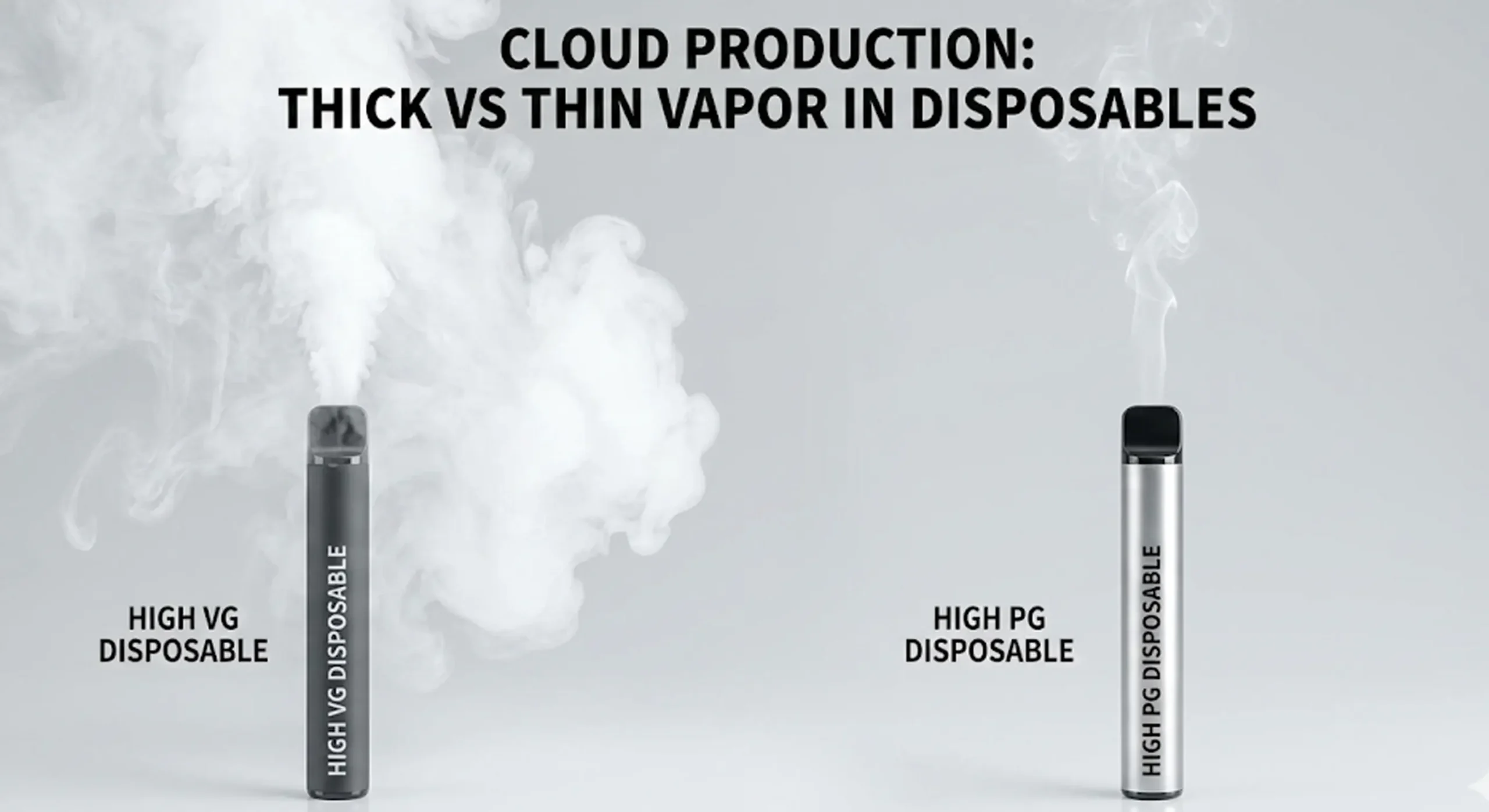
Vegetable Glycerin (VG) is the heavy lifter when it comes to cloud production. It is a thick, viscous substance derived from vegetable oils. Because of its high viscosity and hygroscopic nature (meaning it absorbs moisture from the air), VG does not evaporate as quickly as PG. When it is vaporized, the droplets it forms are larger and denser.
These larger droplets reflect light more effectively, creating the appearance of a thick, opaque white cloud. High-VG e-liquids are the standard for “cloud chasers” using sub-ohm mods. In the disposable market, devices marketed as “Max Cloud” or “DTL” (Direct-to-Lung) often tweak their formulation to include a higher percentage of VG. The trade-off is that VG is a poor carrier of flavor compared to PG and requires more heat to vaporize efficiently, demanding a more powerful battery.
Why High-PG Produces Smaller Clouds
Propylene Glycol (PG) serves a different purpose. It is a thinner, closer-to-water liquid that excels at carrying flavor compounds and providing the “throat hit” that mimics the sensation of smoking combustible cigarettes. Because PG is less viscous, it vaporizes rapidly and creates much smaller droplets.
These fine droplets dissipate quickly in the air, resulting in a discrete, thin vapor that disappears almost instantly. Disposables designed for heavy smokers often lean towards higher PG content or a balanced 50/50 blend to prioritize nicotine satisfaction and flavor clarity over visual flair. If your disposable vape is producing very little visible vapor but delivers strong flavor and a sharp throat hit, it is likely utilizing a high-PG formulation.
Coil Type & Cloud Density
The engine of any vape device is the coil. This small piece of resistive wire is responsible for converting electrical energy from the battery into heat. The surface area of the coil directly correlates to cloud production. A larger surface area allows more e-liquid to be in contact with the heating element simultaneously, resulting in a greater volume of vapor being generated in a single puff.
Mesh Coil vs Regular Coil
This is where the most significant innovation in recent disposable technology has occurred. Traditional “regular” coils are simple springs of wire. While effective, they often heat unevenly, leading to hot spots that can burn the cotton and inconsistent vapor production.
Mesh coils, on the other hand, look like a grid or a strip of metal with holes punched through it. This design drastically increases the surface area significantly compared to a standard wire spiral. Because the mesh covers more of the cotton wick, it ramps up—heats up—much faster and more evenly. This rapid, uniform heating vaporizes a larger amount of e-liquid instantly, producing a cooler, denser, and more flavorful cloud. If you are seeking maximum vapor from a disposable, verifying that the device uses mesh coil technology is the most reliable specification to check.
Battery Power & Heating Consistency
The battery is the heartbeat of the disposable vape. Its voltage output determines how hot the coil gets. Most disposables use a standard lithium-ion chemistry, operating between 3.7V and 4.2V. However, not all disposables manage this power the same way. Some utilize “direct output,” meaning the voltage provided to the coil drops as the battery drains. This results in a noticeable decrease in cloud production as the device nears the end of its life—a common reason why some disposable vapes seem to “burn out” or get weak early.
Premium disposables often include a regulation chip that maintains a constant voltage output regardless of the remaining battery charge. This ensures that the cloud you exhale on the first puff is identical to the cloud on the last puff. Furthermore, the capacity of the battery (measured in mAh) dictates whether the device can sustain the high-power demands of a low-resistance mesh coil without dying prematurely.
Airflow Design & Vapor Volume
Airflow is the often-overlooked hero of cloud production. You can have the most powerful battery and the thickest VG liquid, but without proper airflow, the vapor will be hot, compressed, and minimal.
Airflow design controls how much fresh air mixes with the vapor as it is generated.
- Restricted Airflow (Tight Draw): Common in small, stick-style disposables. This mimics a cigarette and restricts the amount of air passing over the coil. It produces warmer, denser vapor but in smaller overall volumes.
- Open Airflow (Loose Draw): Common in larger, rechargeable disposables. This allows a massive rush of air to cool the coil and expand the vapor, creating large, billowing clouds.
Many modern disposables now feature adjustable airflow sliders. Opening these vents maximizes the air intake, which facilitates “Direct Lung” inhaling—a style essential for generating large clouds. Closing the vent tightens the draw for “Mouth to Lung” vaping, which naturally reduces cloud volume.
Puff Style & User Behavior
Your personal interaction with the device changes the outcome significantly. The physics of vaporization requires a steady balance of air and heat.
If you take short, sharp puffs, the coil does not have enough time to reach its optimal operating temperature, resulting in weak vapor. Conversely, taking extremely long, slow drags allows the coil to heat fully and vaporize more liquid. However, there is a limit; drawing too slowly can cause the coil to overheat and burn the wick because there isn’t enough airflow to cool it down.
“Priming” puffs can also influence density. Taking a short puff to warm the coil followed immediately by a longer puff often yields the best results because the coil is already pre-heated.
Does Bigger Cloud Mean Stronger Vape?
There is a common misconception that a massive cloud equates to a stronger nicotine hit. This is generally false and often the opposite is true.
Cloud production and nicotine delivery are two separate metrics. Huge clouds are usually the result of high VG liquid and high airflow. However, high VG liquids typically carry less nicotine (often 3mg or 6mg in open systems, though disposables often stick to high-strength salts).
A device producing a massive cloud spreads the nicotine across a larger volume of vapor. In contrast, a low-cloud, high-PG device with a tight airflow delivers a concentrated, potent dose of nicotine. Therefore, a bigger cloud provides a sensory fullness and visual satisfaction, but it does not necessarily mean you are absorbing more nicotine per puff.
Why Disposable Vapes Don’t Produce “Huge Clouds”
Despite advancements, disposables will rarely match the “weather systems” created by 200-watt box mods. This limitation is intentional and structural.
- Wattage Limits: Disposables typically max out at 10-15 watts. True cloud chasing rigs operate at 80 watts or higher.
- Coil Size: The physical size of the coil in a disposable is small to fit the compact casing, limiting the surface area compared to a sub-ohm tank.
- Battery Safety: High-wattage output requires high-drain batteries that are bulky and expensive, contradicting the “disposable” and “compact” nature of these devices.
How to Get Better Cloud Production from a Disposable Vape
If you are looking to maximize the output of your current device, there are several techniques you can employ without modifying the hardware. First, ensure your battery is fully charged if the device is rechargeable. A drop in voltage leads directly to a drop in vapor. Second, check the airflow intake. Ensure you aren’t accidentally covering the air holes with your fingers while gripping the device.
If the device has an adjustable slider, open it fully to allow maximum air expansion. Finally, adjust your draw technique. Try a “Direct Lung” inhale—pulling the vapor directly into your lungs like taking a deep breath—rather than holding it in your mouth first. This allows for a faster, deeper airflow that triggers the coil to work harder and produce more vapor.
Best Disposable Vapes for Cloud Production
When shopping for a disposable with cloud production in mind, ignore the flavor names and look at the specifications. You want to prioritize devices that explicitly mention Mesh Coils or Dual Mesh technology. Look for devices with adjustable airflow controls, as this gives you the mechanical ability to open up the draw. Additionally, devices with lower resistance ratings (sub-ohm disposables) and larger battery capacities are physical indicators that the unit is built for performance rather than just nicotine delivery. Brands that market “Turbo Mode” or “Boost Mode” are essentially allowing you to temporarily increase the wattage, which is the surest way to get that dense, satisfying cloud you are looking for.