
Why Disposable Vape Flavor Fades Over Time
There is a specific, frustrating moment every disposable vape user recognizes. You purchase a new device, and the first few hundred puffs are vibrant, crisp, and intensely flavorful. But as the days pass, that initial “pop” begins to dull. The notes of strawberry or icy menthol become muted, flattened, or perhaps even slightly burnt.
This phenomenon is known as flavor fade, and it is not a random occurrence. It is the result of specific interactions between thermodynamics, electrical engineering, and chemical breakdown inside your device.
In this deep-dive guide, we will analyze exactly why disposable vape flavor degrades, looking beyond the basics and into the physics of coil resistance, battery voltage curves, and e-liquid saturation
What “Flavor Fade” Means in Disposable Vapes
Before diagnosing the cause, we must define the entity: Flavor Fade.
In the context of semantic SEO, “flavor fade” is distinct from a “dry hit” (which is a burnt wick) or “vaper’s tongue” (which is olfactory fatigue). Flavor fade refers to the gradual reduction in aerosol density and aromatic intensity produced by the device.
When a disposable vape is new, the internal components are optimized:
- The cotton wicking material is fully saturated.
- The coil is pristine and free of carbon deposits.
- The battery is operating at peak voltage (usually 3.7V to 4.2V).
As you use the device, entropy sets in. The hardware degrades, and the chemistry of the e-liquid changes under heat. Understanding this distinction is crucial because while a “burnt” vape is dangerous and should be tossed, a “faded” vape is often just a sign of normal hardware lifecycle stages.
Coil Wear Is the #1 Reason for Flavor Loss
If we look at the hierarchy of hardware failure, coil degradation is the primary driver of flavor loss.
Disposable vapes typically use small, high-resistance coils (often 1.0 ohm to 1.2 ohm), made from materials like Kanthal or Nichrome, often in a mesh configuration. While mesh coils provide better surface area than traditional round wire, they are not immune to the laws of physics.
The Thermal Cycling Problem
Every time you inhale, the coil heats up rapidly (often reaching 200°C – 250°C) to vaporize the e-liquid. When you stop inhaling, it cools down. This repeated heating and cooling is called thermal cycling. Over thousands of puffs, this stress changes the microscopic structure of the metal, slightly altering its resistance.
Carbon Accumulation (The “Gunk” Factor)
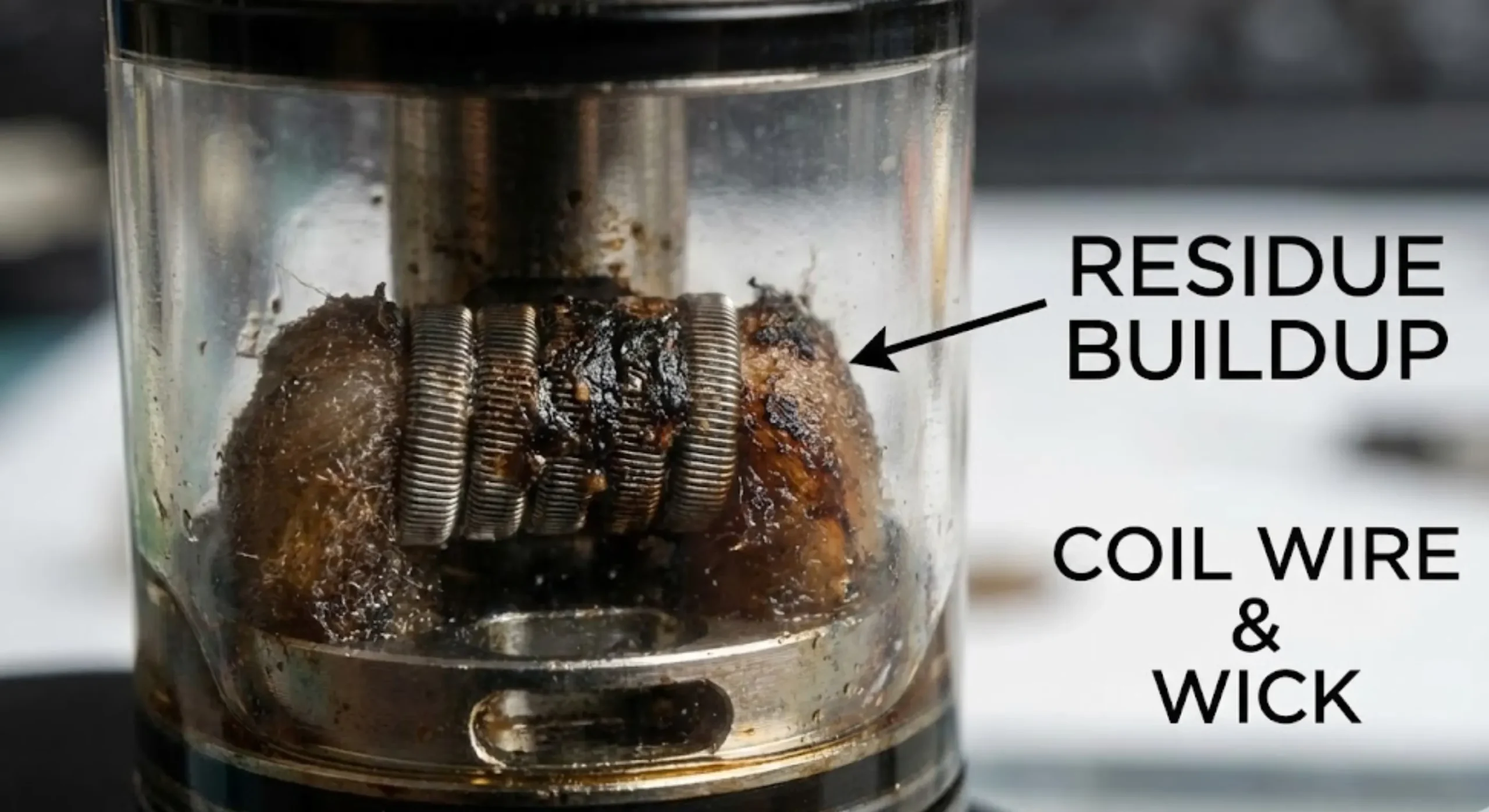
More importantly, vaporizing e-liquid leaves behind residue. Not 100% of the liquid turns to vapor; tiny amounts of solids remain on the coil. Over time, these solids oxidize and form a layer of carbon buildup, often referred to in the community as “coil gunk.”
This carbon layer acts as an insulator. It prevents the heat from the metal coil from transferring efficiently to the fresh e-liquid in the wick. Instead of a sharp, instant vaporization (which creates crisp flavor), you get a slower, uneven heat. This results in:
- Lower vapor production.
- Muted flavor notes (the “high notes” like citrus are the first to disappear).
- A subtle “toasted” background taste.
Sweeteners Damage Flavor Over Time
If coil wear is the mechanical cause of flavor fade, sweeteners are the chemical accelerant.
Modern disposable vapes—especially popular brands known for intense fruit or dessert flavors—rely heavily on sweeteners like Sucralose or Ethyl Maltol. These additives are heavy molecules that do not vaporize as cleanly as Propylene Glycol (PG) or Vegetable Glycerin (VG).
The Caramelization Process
When exposed to the high heat of a vape coil, sucralose undergoes a process similar to caramelizing sugar in a pan. It cooks onto the coil, forming a dark, crusty sludge.
This is why “Sweet” or “Dessert” profiles fade faster than “Menthol” or “Tobacco” profiles.
- High Sweetener Load: The sugar residues clog the porous surface of the coil mesh rapidly.
- Flavor Muting: As the “crust” thickens, it traps the fresh e-liquid, preventing it from touching the heating element directly. You end up tasting the heated residue rather than the fresh juice.
Expert Note: If you notice your flavor fading significantly by day 3 or 4, check the flavor profile. Extremely sweet flavors (like “Blue Razz Ice” or “Cotton Candy”) are chemically predisposed to destroy coils faster than lighter, less sweet options.
Wick Saturation & Dry Areas
Inside your disposable vape is a wicking medium—usually organic cotton or a synthetic silica blend—wrapped around the coil. Its job is to use capillary action to pull e-liquid from the reservoir to the heating element.
The Viscosity Battle
As the e-liquid level in the tank drops, the pressure inside the device changes. Towards the end of the device’s life, the remaining liquid may struggle to travel up the wick as fast as you are vaping it. This creates localized dry spots on the cotton.
When the wick is not fully saturated:
- Air Pockets Form: The coil heats air and dry cotton instead of liquid.
- Temperature Spikes: Liquid acts as a coolant for the coil. Without enough liquid, the coil gets too hot, too fast.
- Singed Cotton: Even if you don’t get a full “dry hit,” micro-singeing of the cotton fibers introduces a stale, cardboard-like taste that overpowers the e-liquid flavor.
This is a failure of hydrodynamics. If the wick cannot keep up with the rate of vaporization, flavor intensity immediately drops because the aerosol density (the amount of vapor per puff) decreases.
Battery Voltage Drops Near End of Life
This is often the most overlooked technical factor in flavor fade. Most disposable vapes use Lithium-Ion polymer batteries.
Unlike a regulated box mod that boosts voltage to keep the power constant, most disposables operate on “Direct Output” voltage. This means the power the coil receives is directly tied to the current charge of the battery.
The Discharge Curve
- Full Charge (100%): The battery outputs ~4.2 Volts. The vapor is warm, dense, and flavorful.
- Mid Charge (50%): The battery outputs ~3.7 Volts. This is the “nominal” voltage where the device performs mostly as intended.
- Low Charge (<20%): The voltage can drop to 3.3V or lower.
As the voltage drops, the wattage (power) hitting the coil drops significantly.
- Formula: $Power = Voltage^2 / Resistance$
A small drop in voltage results in a large drop in power. At 3.3V, the coil isn’t getting enough energy to vaporize the liquid properly. It produces a cool, thin, wispy vapor that lacks “body” and flavor depth. If your vape tastes weak but not burnt, it is almost certainly a voltage issue, not a liquid issue.
PG/VG Ratio Affects Flavor Longevity
The composition of the e-liquid itself dictates how well it carries flavor and how likely it is to clog your device. E-liquid is primarily a mix of Propylene Glycol (PG) and Vegetable Glycerin (VG).
The Role of PG (The Flavor Carrier)
PG is a thin, watery substance. It is the primary carrier for flavor concentrates and nicotine. High PG liquids provide a strong “throat hit” and very pure flavor transfer.
The Role of VG (The Vapor Producer)
VG is a thick, viscous vegetable oil derivative. It creates dense clouds but is a poor carrier of flavor (it actually holds a slight natural sweetness that can mask other notes).
Most disposable vapes use a 50/50 or 60/40 VG/PG ratio. This is a delicate balance.
- If VG is too high: The liquid is too thick. It won’t wick fast enough into the small coils of a disposable, leading to dry hits and flavor fade due to poor saturation.
- If PG is too high: The liquid is too thin and may leak, flooding the coil. A flooded coil boils the liquid rather than vaporizing it, leading to “spit-back” and a loss of flavor definition.
Manufacturers optimize this ratio for the first 50% of the device’s life. However, as the device sits, separation can occur, or the volatile flavor compounds in the PG can evaporate if the device isn’t sealed perfectly, leaving behind a heavier, VG-dominant mix that tastes muted.
Read: PG/VG Ratio in Disposable Vapes
User Puff Style Accelerates Flavor Fade
How you vape matters just as much as what you vape. Your “puff topology”—the frequency and duration of your inhalation—directly impacts the longevity of the coil and wick. While manufacturers advertise a specific “Puff Count” (e.g., 5000 puffs), this is based on short, machine-test puffs (usually 1-1.5 seconds). If you take long, deep draws (3-5 seconds), you are putting three times the stress on the coil per puff.
The “Chain Vaping” Effect
Chain vaping (taking multiple puffs in rapid succession) is the fastest way to kill flavor.
When you vape rapidly, the coil stays hot, and the wick doesn’t have time to re-absorb liquid. This dries out the wick faster than capillary action can replenish it. The result is a phenomenon called “Heat Soak,” where the entire device gets hot, degrading the e-liquid in the reservoir and breaking down the flavor molecules before they are even vaporized.
Is Flavor Fade a Sign the Vape Is Finished?
Not necessarily, but it is a warning sign. You must distinguish between Flavor Fade and End-of-Life.
- Muted Flavor + Low Vapor: This usually indicates a low battery. If the device is rechargeable, charge it. If the flavor returns, the device is still good.
- Burnt/Charred Taste: This means the wick is damaged or the liquid is completely gone. The device is finished and unsafe to use.
- Flavor Ghosting: Sometimes, you might taste the previous flavor notes mixing with a burnt taste. This indicates the coil gunk is severe.
Verdict: If the flavor has faded but is not burnt, the device is likely near the end of its e-liquid supply or the coil is heavily fouled. It is essentially the “pre-game” to the device dying completely.
How to Make Disposable Vape Flavor Last Longer
While you cannot fight the laws of physics forever, you can extend the “Flavor Horizon” of your device by altering your usage habits. Here is a semantic list of actionable steps to preserve flavor integrity:
- Avoid Chain Vaping: Follow the “15-second rule.” Wait at least 15-30 seconds between puffs to allow the wick to fully re-saturate with e-liquid. This keeps every hit juicy.
- Store at Room Temperature: Extreme heat (like a car dashboard) thins the liquid and degrades the nicotine and flavor molecules. Extreme cold makes the VG too thick to wick properly.
- Keep It Upright: Storing a disposable vape upright ensures gravity helps the e-liquid feed into the wicking ports, preventing dry starts.
- Don’t Overcharge (If Rechargeable): Don’t leave rechargeable disposables plugged in overnight. Overcharging can heat the battery, which transfers heat to the e-liquid tank, “cooking” the flavor while the device is idle.
- Choose “Icy” Flavors for Longevity: Menthol and Koolada (cooling agents) tend to hide the taste of coil degradation better than pure pastry or custard flavors. If you want a device that tastes consistent until the very last drop, Ice profiles are chemically more stable.
By understanding the mechanics of coil resistance, voltage drop, and fluid dynamics, you can manage your expectations and your device better. Flavor fade is inevitable—it is the nature of consumable hardware—but with the right habits, you can keep that “day one” fresh taste for much longer.