How Disposable Vapes Work (Battery, Coil, Nic Salt Explained)
Disposable vapes may look simple from the outside, but inside each device is a complete vapor production system designed to activate automatically when you inhale. Your puff triggers the airflow sensor, the sensor signals the chipset, the chipset draws power from the battery, and the coil heats the nicotine salt e-liquid into vapor. This seamless chain—battery to coil to wick to vapor—is the reason disposables are effortless, smooth, and powerful despite their small size.
Most of the performance differences between devices come from how efficiently this internal system is engineered. Brands that use better mesh coils, improved cotton, stronger airflow design, and stable batteries deliver noticeably smoother flavor, more consistent puffs, and longer overall lifespan. Understanding how the internal components work together gives you a deeper idea of why some disposables feel premium while others burn out early or lose flavor midway.
The Core Components Inside a Disposable Vape
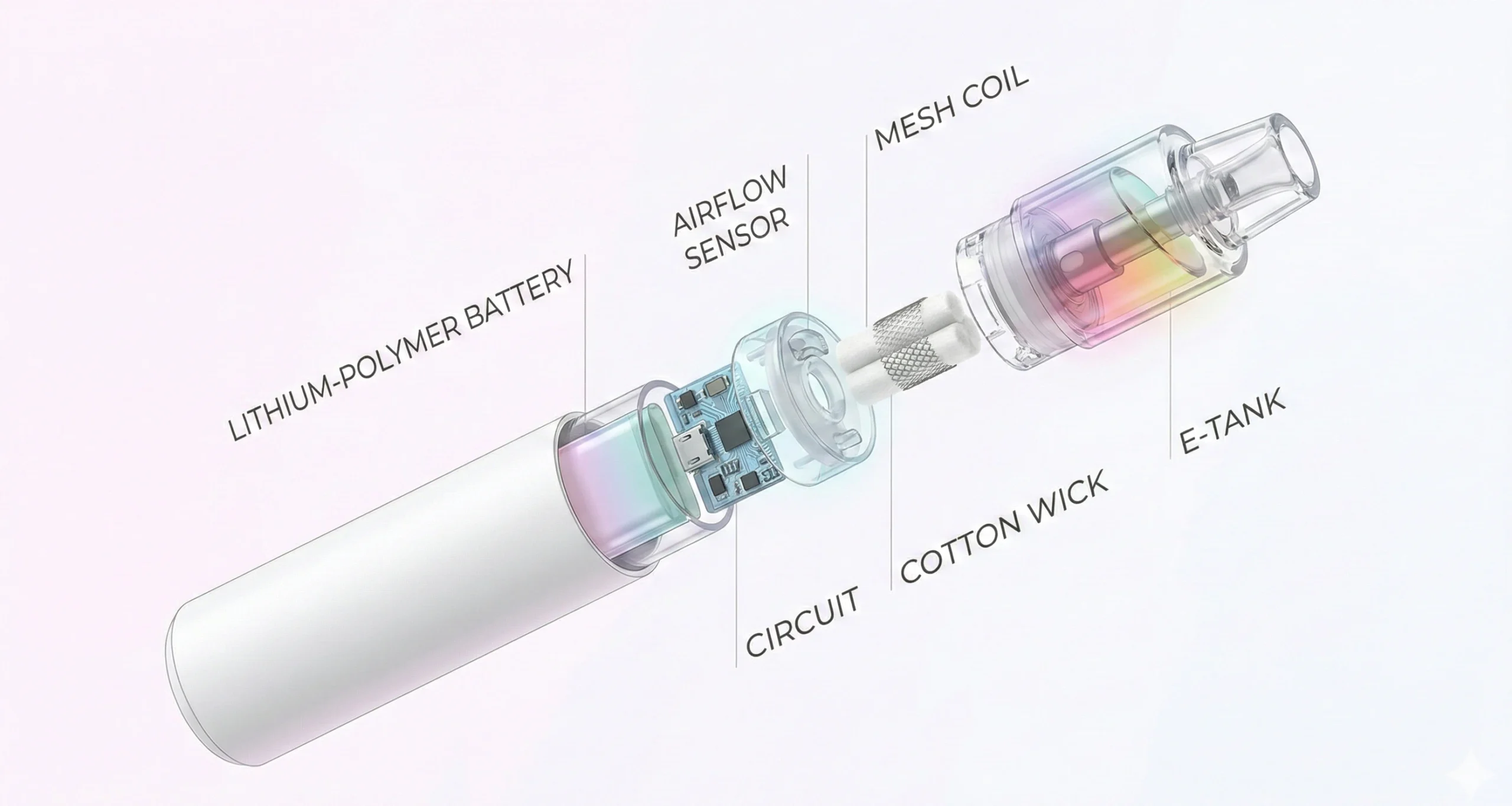
Inside every disposable vape, several components work in harmony to create vapor. The battery supplies power, the chipset regulates it, the coil heats the e-liquid, the wick holds and delivers the e-liquid to the coil, the tank stores the liquid, and the airflow sensor activates everything automatically. When each of these elements is well-designed, vapor production becomes consistent from the first puff to the last.
Battery
The battery is the core power source of the device. Disposable vapes commonly use 3.7V lithium-ion cells that deliver stable voltage throughout most of the device’s lifespan. Even though disposables do not allow recharging in older models, the battery is optimized to maintain sufficient voltage until the e-liquid reservoir is nearly empty. Modern rechargeable disposables use stronger batteries because higher-capacity devices (such as 10,000–20,000 puff models) need sustained output without flavor drop-off.
The battery’s stability directly affects vapor quality. If voltage dips too quickly, the coil won’t heat evenly, resulting in weak vapor and inconsistent flavor. High-quality brands use regulated chipsets to ensure smooth power delivery.
Coil
The coil is the heating element responsible for turning e-liquid into vapor. Today’s disposables mainly use mesh coils instead of traditional round-wire coils. Mesh coils heat evenly across a larger surface area, producing denser vapor and richer flavor. This design also reduces the chances of burning the wick because heat is distributed gently.
A good coil design is often the biggest factor behind smooth, flavorful puffs. Poor coil quality leads to burnt hits, uneven heating, or flavor fading after a few hundred puffs.
E-liquid Tank
The tank stores the nicotine salt e-liquid inside the device. Its size determines the total puff count. Most tanks are sealed to prevent leaking and maintain hygiene. The stability of the tank ensures that e-liquid flows correctly to the wick without flooding or dry spots.
The composition of the e-liquid inside the tank also matters. Nicotine salts vaporize at lower temperatures, which is why disposables don’t require high-wattage coils like advanced vape devices.
Wick
The wick, usually made from organic cotton, delivers e-liquid to the coil. It functions like a sponge, absorbing liquid from the tank and feeding it directly to the heating element. The wick must always remain saturated for clean vapor production. If the cotton dries out, the coil burns the cotton fibers, resulting in an unpleasant burnt taste.
When you experience smooth, stable flavor throughout a device’s life, it’s usually because the wick density, positioning, and absorption rate are engineered correctly.
Airflow Sensor
The airflow sensor detects your inhale and activates the heating system without the need for a button. This sensor responds instantly when air passes through, triggering the chipset and allowing the coil to heat at the exact moment you draw.
A sensitive airflow sensor is essential for smooth activation. If the sensor is weak or poorly calibrated, the user must inhale harder, or the device may fail to activate.
How the Battery Powers the Device
When you take a puff, the airflow sensor signals the chipset that controls power delivery. The chipset determines how much voltage the coil receives and for how long. This micro-level control prevents overheating, burnt hits, and coil damage.
A steady power flow ensures the coil heats evenly and vaporizes the liquid at the correct temperature. If the battery were to send power directly without regulation, disposables would burn out quickly or deliver unstable vapor. High-quality devices rely heavily on this power management system to maintain flavor consistency from the first puff to the last.
The Role of the Wick (Cotton Saturation)
The wick’s job is to continuously supply e-liquid to the heated coil. Proper cotton saturation is the key to preventing dry hits. When the wick is perfectly soaked, the vapor feels smooth, flavors stay pure, and nicotine delivery remains stable.
Overly dense cotton can restrict e-liquid flow and cause partial dry hits, while cotton that is too loose may oversaturate the coil, leading to spit-back or gurgling. Manufacturers fine-tune the wick’s density to match the coil type and tank size, ensuring a balanced flow at all times.
How Nicotine Salts Create Smooth Vapor
Nicotine salts are specifically used in disposable vapes because they vaporize effectively at low temperatures and provide a smooth throat hit, even at higher nicotine strengths. Unlike freebase nicotine, which becomes harsh at high concentrations, nic salts remain gentle while delivering rapid nicotine satisfaction.
This low-temperature efficiency allows disposable vapes to remain compact, as they do not require powerful batteries or high-wattage coils. The smooth flavor and gentle throat feel associated with disposables come largely from nicotine salt formulations.
How Vapor Is Produced Inside the Device
When you inhale, air enters through the airflow channel and activates the airflow sensor. The sensor triggers the chipset, which draws controlled power from the battery and sends it to the coil. The coil heats rapidly, evaporating the e-liquid absorbed by the wick.
This freshly formed vapor travels upward through the internal chimney and reaches the mouthpiece. The entire sequence happens instantly—activation, heating, vaporization, and airflow delivery all sync together with every puff.
Efficient vapor production depends on several factors: balanced airflow, consistent coil temperature, proper wick saturation, and stable battery output. When all of these are optimized, the user receives smooth and flavorful vapor every time.
The Auto-Draw Airflow System
The auto-draw system enables buttonless operation. Your inhale activates pressure sensors that detect changes in airflow. This triggers the chipset, which then powers the coil. Auto-draw technology is designed to mimic the natural inhaling pattern of smoking a cigarette, which is why disposables are so intuitive for beginners.
Superior airflow design improves flavor intensity, reduces turbulence, and ensures the coil receives adequate cooling during puffing. Poor airflow design results in whistle-like sounds, weak vapor, or overheating.
What Controls Puff Count & Lifespan
Puff count varies depending on e-liquid capacity, coil efficiency, wattage stability, and airflow design. Devices with optimized power output and well-engineered mesh coils produce more vapor using less liquid, extending lifespan. Meanwhile, poorly designed disposables burn liquid too quickly or deliver inconsistent puffs, reducing total usage time.
Battery-to-coil efficiency plays a major role. If the coil requires more power to heat, the battery drains faster, reducing available puffs even if e-liquid remains.
Why Some Disposables Perform Better Than Others
Premium disposable vapes outperform others due to better engineering in several areas. High-quality mesh coils produce dense vapor and consistent flavor. Superior cotton maintains stable saturation without burning. Chipsets regulate power precisely to prevent overheating. Batteries with stable discharge curves keep flavor strong until the final puffs.
Even airflow design makes a huge difference—smooth airflow enhances flavor, cools the coil naturally, and improves overall vapor production. When these internal systems are tuned correctly, the disposable feels smoother, lasts longer, and tastes cleaner.