
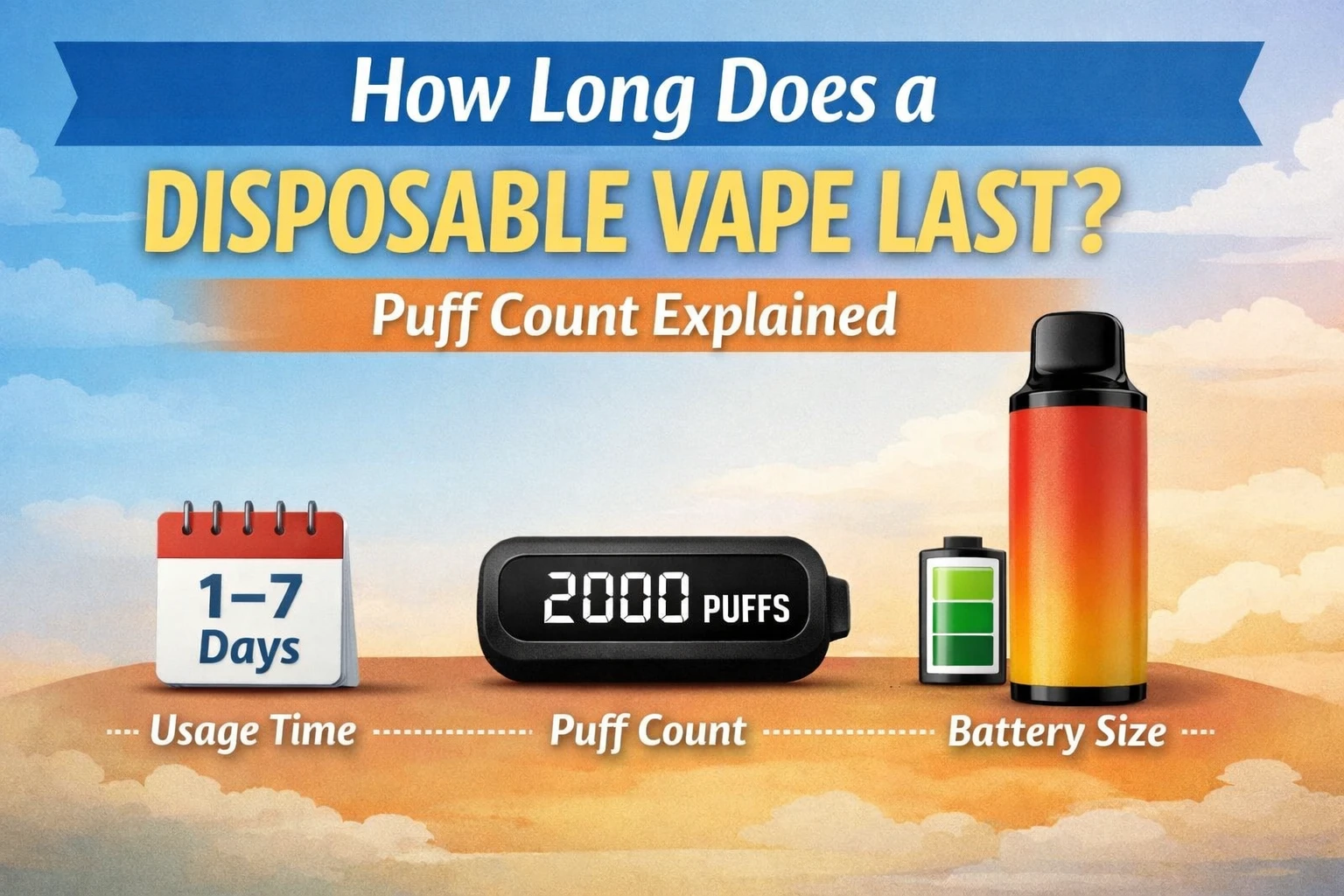
How Long Does a Disposable Vape Last?
For the modern vaper, few things are as frustrating as a device dying mid-puff. Whether you are transitioning from smoking or simply enjoy the convenience of a “grab-and-go” device, one question inevitably arises: How long does a disposable vape actually last?
While the packaging might promise thousands of puffs, the reality is often nuanced. It depends on a complex interplay between hardware specifications—like battery capacity (mAh) and e-liquid volume—and your personal usage habits. This guide dives deep into the lifespan of disposable vapes, moving beyond marketing claims to give you real-world expectations.
What Manufacturers Mean by “Puff Count”
When you browse disposable vapes, the “puff count” is usually the biggest number on the box. You’ll see devices rated for 600, 5,000, or even 10,000 puffs. However, understanding how manufacturers calculate this number is crucial for managing your expectations.
From a manufacturing standpoint, a “puff” is often determined by a standard machine test. These laboratory conditions are perfect: they use a specific puff duration (usually very short, around 1 second) and consistent draw pressure.
The Reality Gap
In the real world, no two humans vape exactly alike. If the manufacturer bases their count on a 1-second draw, but your average inhalation is 3 seconds, you are effectively consuming three “manufacturer puffs” every time you hit the device. Therefore, a device rated for 3,000 puffs might only last you 1,000 actual draws if you prefer deep, long inhalations (often called Direct-to-Lung or restricted DTL).
Key Takeaway: Treat puff counts as a maximum potential ceiling, not a guaranteed minimum. It is a comparative metric, not an absolute timer.
Average Lifespan of Disposable Vapes
To understand longevity, we must look at time frames rather than just puff numbers. The lifespan generally correlates with the e-liquid capacity and battery size, but user behavior is the variable that changes the equation.
Here is a breakdown based on typical usage patterns:
- Light Vapers (Social/Occasional): If you only use your vape during breaks or social outings, a standard 600-puff device (approx. 2ml of e-liquid) can last 3 to 5 days. High-capacity devices (5,000+ puffs) could last you two weeks or more.
- Moderate Vapers: For those who vape consistently throughout the day but not constantly, a standard device might last 1 to 2 days. A larger rechargeable disposable (10ml+ capacity) typically lasts 5 to 7 days.
- Heavy Vapers (Chain Vapers): If the device is constantly in your hand, you will burn through e-liquid much faster. A 600-puff bar might not last a full 24 hours. Heavy users often require rechargeable disposables to ensure they can consume the full e-liquid reservoir without the battery dying first.
Factors That Affect How Long a Disposable Vape Lasts
Why does your friend’s vape last a week while yours dies in three days, even if you bought the exact same model? The lifespan is dictated by three primary “vectors”: Hardware, Liquid, and User Behavior.
1. Battery Capacity (mAh)
The battery is the engine of the device. Measured in milliampere-hours (mAh), this determines how long the heating element can be powered.
- Non-rechargeable devices rely entirely on the battery. Once the battery dies, the device is finished, even if there is juice left.
- Rechargeable devices allow you to recharge the battery, ensuring the limiting factor is the e-liquid, not the power.
2. Coil Resistance and Type
The coil is the heating element that vaporizes the liquid.
- Mesh Coils: Modern disposables often use mesh coils. While they provide better flavor and faster heating, they also have a larger surface area. This consumes e-liquid faster than traditional round wire coils.
- Low Resistance (Sub-Ohm): Lower resistance creates hotter, denser vapor but drains both battery and liquid more rapidly.
3. E-Liquid Capacity
This is the fuel tank. A device with 2ml of e-liquid physically cannot last as long as one with 13ml, regardless of how small the puffs are.
Signs Your Disposable Vape Is Near the End
Recognizing when your device is about to fail can save you from carrying around a dead weight. There is a distinction between the battery dying and the e-liquid running out, though the symptoms can overlap.
How to Know When a Disposable Vape Is Empty
- The Burnt Taste: This is the most obvious sign. When the wicking material inside the coil dries out because there is no e-liquid left to saturate it, the heat singes the cotton. This results in a harsh, acrid “dry hit.” If you taste burning, the device is done.
- Diminished Flavor: Before the burnt taste arrives, you will often notice the flavor becoming muted or “thin.” The vapor production may also decrease significantly.
- The Blinking Light: Most disposables have an LED indicator.
- If it blinks when you try to inhale, and no vapor comes out, the battery is dead.
- On a non-rechargeable device, this means it’s time to throw it away.
- On a rechargeable device, simply plug it in (usually USB-C).
- Airflow Changes: Sometimes, a device that is nearly empty will feel “airy” as the saturation in the coil changes, altering the draw resistance.
Why Some Disposable Vapes Finish Early
It is not uncommon for users to feel “short-changed” by a disposable vape. You might wonder, Why did this burn out so early? Several factors contribute to premature failure:
- Chain Vaping: Taking rapid, successive puffs does not give the wicking material enough time to re-saturate with e-liquid. This can burn the coil (wicking) long before the juice is actually gone. Once the wick is burnt, the flavor is ruined permanently.
- Cold Weather: Lithium-ion batteries perform poorly in cold temperatures. If you leave your vape in a cold car, the battery may discharge faster or fail to power the coil properly.
- Leakage: If the device was stored improperly (e.g., upside down or at high altitude), e-liquid may have leaked out of the tank or into the airflow sensor, causing auto-firing (where the device activates on its own) or simply wasting juice.
- The “Dud” Factor: Occasionally, mass-produced electronics fail. A battery might have self-discharged while sitting on a shelf for months before you bought it.
How to Make a Disposable Vape Last Longer
If you want to stretch your dollar and get the maximum puff count possible, you need to adjust how you handle the device. Here are actionable tips to extend longevity:
- Take Smaller Puffs: Since puff counts are based on short draws, mimicking this behavior is the best way to match the manufacturer’s rating. Avoid 5-second “cloud chasing” inhales.
- Wait Between Puffs: Give the device 15 to 30 seconds between hits. This allows the battery to cool down and the cotton wick to fully absorb more e-liquid. This prevents dry hits and extends coil life.
- Store at Room Temperature: Extreme heat (like direct sunlight) can thin the e-liquid, leading to leaks, while extreme cold drains the battery. Keep it temperate.
- Avoid Covering Airflow Holes: If you accidentally cover the intake holes at the bottom or side of the device while holding it, the sensor has to work harder, and the coil heats up more intensely due to lack of cooling airflow. This stresses the system.
Is Rechargeable Disposable Better for Longevity?
In the evolution of disposables, the rechargeable disposable is a game-changer for longevity.
With a standard, non-rechargeable “stick” vape, manufacturers must balance the battery size with the liquid amount. Often, the battery dies while there is still 10-20% of the liquid left in the reservoir—liquid you paid for but can’t use.
Rechargeable disposables solve this efficiency problem. They typically come with much larger e-liquid tanks (10ml to 15ml). Because you can recharge the battery multiple times, you are guaranteed to be able to vape every single drop of liquid. While the initial cost might be slightly higher, the cost per puff is generally much lower, and the total lifespan is significantly longer (often 1-2 weeks for a single device).
Real-Life Usage Examples
To put this into perspective, let’s look at two hypothetical users and how different devices serve them.
Case A: The Weekend Warrior
- User: Sarah, who only vapes when out with friends on Friday and Saturday nights.
- Device: A standard 600-puff non-rechargeable bar.
- Result: Because her usage is clustered and low-volume, the battery doesn’t suffer from self-discharge issues. This single device lasts her 3 weekends. The small form factor is perfect for her purse.
Case B: The Daily Commuter
- User: Mark, a former pack-a-day smoker who vapes during his hour-long commute and breaks.
- Device: A standard 600-puff non-rechargeable bar.
- Result: Mark finds the device dies by Tuesday afternoon. He is spending $10 every two days.
- Better Solution: Mark switches to a 5,000-puff rechargeable disposable. Even though he vapes heavily, the ability to recharge the battery means he only needs to buy a new device once every 10 days. He saves money and generates less plastic waste.
Conclusion
The question “How long does a disposable vape last?” doesn’t have a single answer, but it does have a formula: (E-Liquid Capacity + Battery Efficiency) ÷ Your Vaping Style = Lifespan.
By understanding the difference between manufacturer puff counts and real-world usage, and by recognizing the signs of a dying device, you can make smarter purchasing decisions. If longevity is your priority, look for rechargeable options with high e-liquid capacity. If convenience is key, standard disposables serve a purpose—just remember to take shorter puffs to make them go the distance.